
EmDeNet
The German electricity grid is changing fundamentally as part of the energy transition. On the one hand, the majority of fossil fuel power plants will be phased out over the next few years and replaced by a large number of smaller generators, while on the other hand consumer behaviour is changing, e.g. due to the strong growth in e-mobility or heat pumps. Both developments lead to a need for action and expansion of the existing electricity grids, but they also have an impact on the energy behaviour of households or blocks of flats. Whereas households or blocks of flats used to be pure electricity consumers, they are increasingly being equipped with generation systems such as PV systems or combined heat and power plants, turning them into so-called "flexumers" that act as electricity consumers at some times and as electricity generators at others. It is in the interests of both the system operator and the grid operator that as much of the generated electricity as possible is consumed by the system operator. If the generation systems are combined heat and power plants, it is also necessary to coordinate them with the heat consumption of the building in question.
Against this background, the EmDeNetz project aims to develop an energy management system consisting of distributed energy managers, which optimises both the financial benefit of the plant operators, e.g. by coordinating the timing of generation with their own electricity and heat requirements, and the benefit of the grid operator through the grid-friendly behaviour of the plants. For these purposes, the energy management system will be used to link individual systems to form a "virtual power plant" in order to jointly market their surplus power on electricity and control power markets. The use of AI and machine learning is also planned in order to optimally adapt each energy manager to the components it controls and their individual aspects.
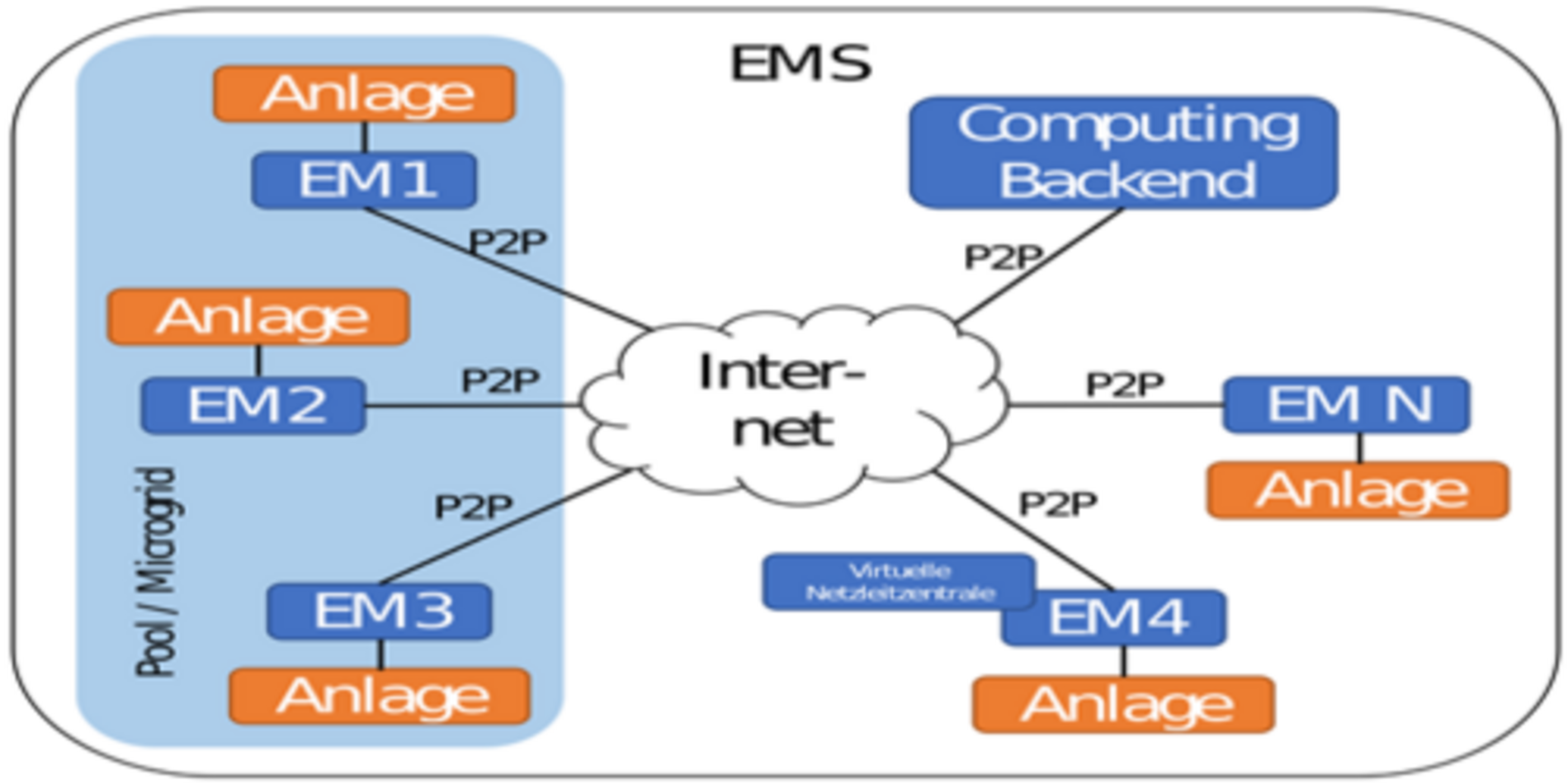
The focus of the work at the OTH is on the development of the optimisation algorithm for system deployment planning, particularly with regard to grid-friendly deployment. To this end, suitable parameters are to be determined in order to quantify the usefulness for the grid and, furthermore, methods are to be developed in order to determine the effects of the system deployment on the grid and to take them into account in the deployment planning
The EmDeNetz project is part of the IntelliZell network (intelligent energy distribution for grid relief at cell level) in the Regensburg e-mobility cluster and is funded by the Federal Ministry for Economic Affairs and Energy as part of the Central Innovation Programme for SMEs (ZIM).